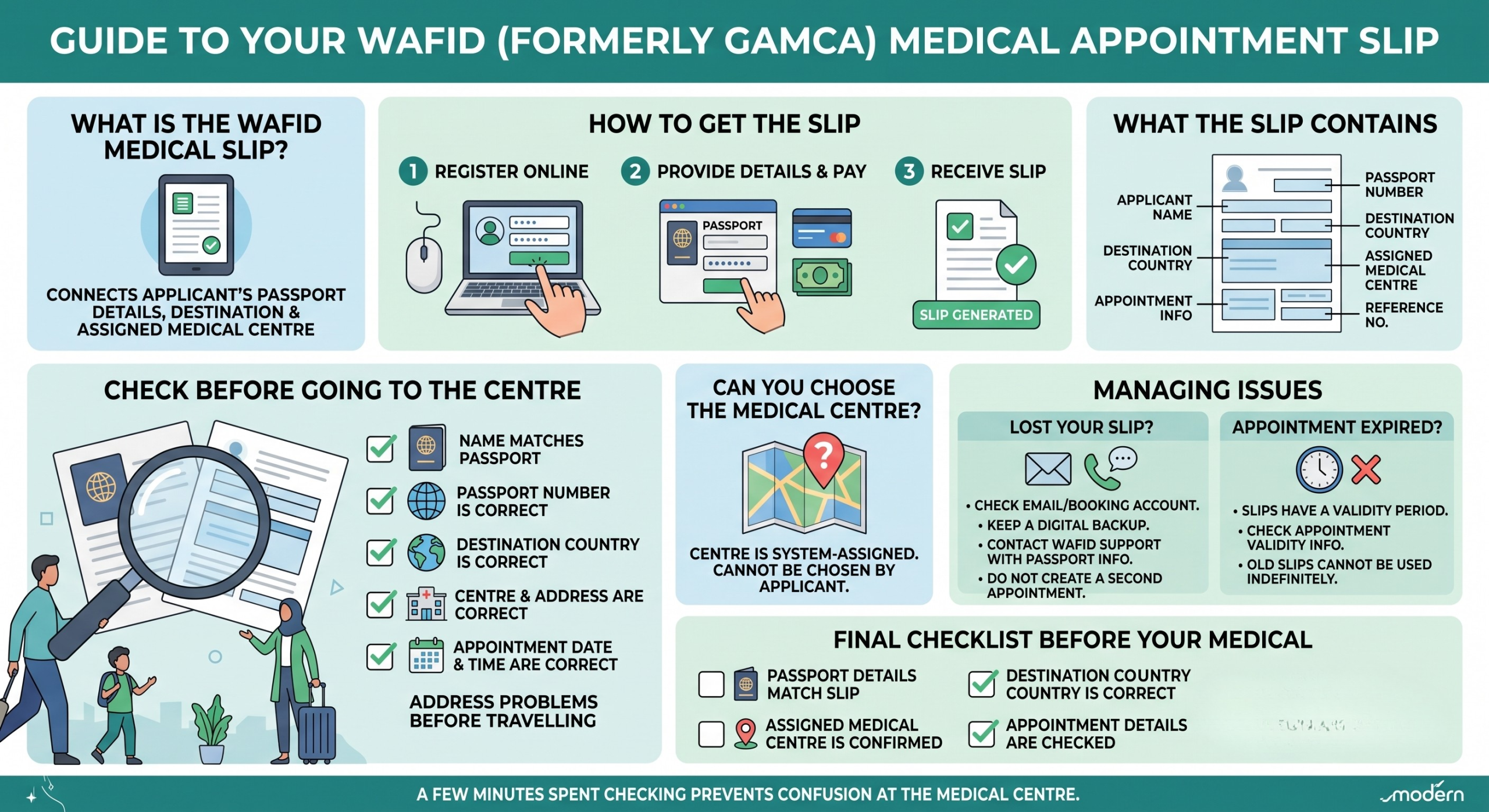
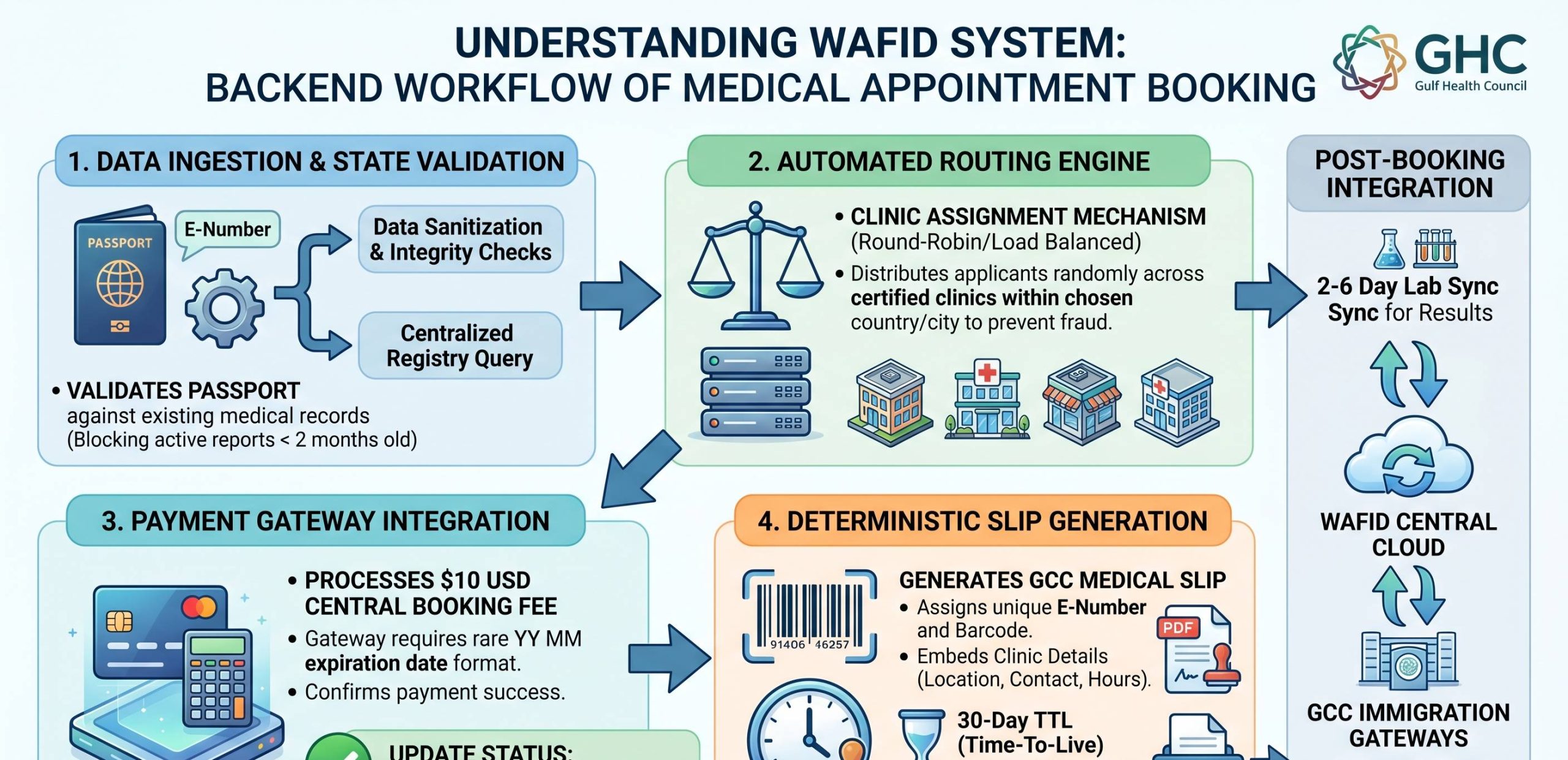
Why the WAFID Booking System Matters
For millions of expatriates seeking employment across the Gulf Cooperation Council (GCC) countries, the WAFID medical examination serves as one of the most important pre-departure requirements. Before a worker can obtain a visa for countries such as Saudi Arabia, Kuwait, Qatar, Oman, Bahrain, or the UAE, they must successfully complete a medical fitness assessment through a GCC-approved medical center.
Most applicants only see the front-end process: entering passport details, paying fees, receiving an appointment, and visiting a medical centre. Behind that seemingly simple workflow, however, operates a complex digital infrastructure designed to coordinate applicants, medical centres, government authorities, laboratories, and immigration systems across multiple countries.
The backend architecture of the WAFID appointment system plays a critical role in preventing fraud, managing appointment distribution, maintaining medical record integrity, and supporting GCC public health regulations.
From Applicant Registration to System Validation
The workflow begins the moment an applicant enters their information into the WAFID platform.
At this stage, the system typically collects:
- Passport information
- Nationality
- Destination country
- Visa category
- Contact details
- Identification records
Before an appointment is generated, the backend system performs multiple validation checks.
Data Verification Layer
The platform evaluates whether:
- Passport numbers follow valid formats.
- Duplicate registrations exist
- Applicant records already exist in the database.
- Country-specific eligibility requirements are satisfied.
This initial validation stage helps reduce duplicate appointments and minimises fraudulent registrations.
Instead of simply storing data, the system actively evaluates whether the submitted information qualifies for appointment generation.
Automated Medical Centre Allocation
One of the most misunderstood aspects of WAFID is the medical centre assignment.
Many applicants believe they can freely choose any approved medical centre. In reality, the backend system often manages appointment allocation automatically.
Why Automatic Allocation Exists
The allocation engine is designed to:
- Distribute applicants fairly
- Prevent overcrowding
- Reduce centre manipulation
- Limit agent interference
- Maintain operational balance
Rather than allowing unrestricted selection, the system evaluates availability and assigns applicants according to predefined allocation rules.
This mechanism significantly reduces opportunities for appointment fraud and preferential treatment.
How the Allocation Logic Works
Although exact algorithms are not publicly disclosed, the workflow generally follows several allocation factors.
The system may consider:
- Geographic region
- Applicant location
- Medical centre capacity
- Daily appointment limits
- Operational availability
- GCC country requirements
Conceptually, the process resembles a distribution model:
f(a)=\frac{A}{C}
Where:
- (A) represents applicant demand
- © represents available centre capacity
The objective is to balance workload across approved facilities while maintaining processing efficiency.
Appointment Generation and Unique Tracking IDs
Once allocation is complete, the system generates a unique appointment record.
Each registration is associated with identifiers used throughout the medical workflow.
These identifiers may support:
- Applicant tracking
- Medical record linkage
- Laboratory reporting
- Immigration verification
- Fraud prevention mechanisms
The appointment confirmation serves as more than a booking receipt—it becomes the digital reference point for every subsequent medical process.
Payment Processing Integration
The booking system integrates payment verification before appointment activation.
Backend Payment Workflow
The system typically performs:
- Payment initiation
- Transaction verification
- Status confirmation
- Record synchronization
- Appointment activation
If payment verification fails, appointment generation may be suspended automatically.
This prevents unauthorised bookings and helps ensure that appointment slots are reserved only for completed registrations.
Medical Centre Synchronisation
After appointment generation, information is transmitted to the assigned medical centre.
The synchronisation process allows medical facilities to access:
- Applicant identification details
- Appointment schedules
- Destination country requirements
- Examination instructions
This eliminates the need for manual data re-entry and reduces administrative errors.
Medical centres receive information directly from centralised databases, creating a more consistent workflow across approved facilities.
The Examination-Day Workflow
When applicants arrive at their assigned medical centre, backend verification continues.
Medical staff generally retrieve appointment records using:
- Passport numbers
- Registration numbers
- Appointment IDs
- Barcode systems
- QR code verification
The purpose is to ensure that:
- The correct applicant is present.
- The appointment is authentic.
- No duplicate examination exists.
Identity verification remains a critical security layer within the system.
Laboratory Data Management
After sample collection, laboratory results become part of the centralised workflow.
Medical testing typically includes:
- Blood screening
- Infectious disease testing
- Chest radiology
- Physical examinations
Instead of relying entirely on paper documentation, results are uploaded digitally.
Why Digital Uploading Matters
Digital reporting helps:
- Reduce document tampering
- Improve auditability
- Accelerate result delivery
- Strengthen compliance monitoring
Once uploaded, results can be reviewed within the broader WAFID ecosystem.
Medical Review and Fitness Classification
One of the most important backend stages occurs after laboratory submission.
Medical officers review diagnostic findings before assigning a final status.
The classification workflow generally includes:
- Preliminary review
- Quality validation
- Diagnostic confirmation
- Fitness determination
Final outcomes usually fall into categories such as:
- Fit
- Unfit
- Further evaluation required
- Pending review
The decision is then stored within centralised databases for future verification.
Fraud Prevention Mechanisms Built into the System
Fraud prevention is one of the core reasons the WAFID platform relies heavily on centralised digital infrastructure.
Common Fraud Risks the System Attempts to Address
- Fake appointment letters
- Duplicate registrations
- Identity substitution
- Forged medical reports
- Unauthorised medical centre manipulation
To reduce these risks, backend controls often include:
- Unique registration identifiers
- Centralized databases
- Digital report submission
- Controlled appointment allocation
- Verification checkpoints
The system is designed to make unauthorised modifications significantly more difficult.
How GCC Governments Use the Data
Medical screening data is not isolated within individual clinics.
The broader objective is to support:
- Immigration compliance
- Public health monitoring
- Workforce regulation
- Disease surveillance
- Cross-border verification
Because GCC countries receive millions of expatriate workers annually, centralised medical screening data plays an important role in workforce management strategies.
The Role of APIs and System Integration
Modern WAFID infrastructure increasingly depends on system integration.
Backend communication may occur between:
- Medical centers
- Diagnostic laboratories
- Payment gateways
- Government databases
- Immigration systems
These integrations allow information to move efficiently between stakeholders without requiring repeated manual processing.
As digital governance expands across GCC countries, interoperability becomes increasingly important.
Why Applicants Sometimes Face Delays
Many applicants assume delays occur only at medical centres.
In reality, backend bottlenecks can occur during several stages:
Possible Delay Points
- Payment verification failures
- Database synchronisation issues
- Medical report reviews
- Additional laboratory confirmations
- System maintenance windows
- Identity verification mismatches
Understanding these backend processes helps explain why some applications require additional processing time even when medical examinations have already been completed.
The Shift Toward Fully Digital Medical Verification
Over the past decade, GCC medical screening systems have undergone a significant digital transformation.
Older workflows often relied heavily on:
- Paper reports
- Manual verification
- Physical document transfers
Modern systems increasingly utilise:
- Centralized databases
- Electronic records
- Automated validation
- Digital appointment tracking
- Online result verification
This transition improves efficiency while reducing opportunities for fraud.
What the Future of WAFID Infrastructure May Look Like
As GCC governments continue expanding digital public services, future developments may include:
- AI-assisted verification systems
- Enhanced biometric integration
- Real-time health record synchronisation
- Advanced fraud detection tools
- Cross-country medical database connectivity
- Automated compliance monitoring
The long-term trend points toward greater automation, stronger verification protocols, and deeper integration between healthcare and immigration systems.
Final Perspective
Most applicants experience WAFID as a straightforward online booking platform, but the underlying infrastructure is far more sophisticated. Behind every appointment lies a multilayered workflow involving validation engines, allocation systems, payment gateways, medical databases, laboratory integrations, and regulatory compliance mechanisms.
The backend architecture exists not only to schedule appointments but also to support public health objectives, maintain medical record integrity, prevent fraud, and streamline expatriate workforce management across GCC countries.
For applicants, understanding how the system operates behind the scenes provides valuable insight into why appointment allocation, verification procedures, and medical reporting processes are structured the way they are. The result is a more secure, standardised, and scalable framework capable of handling millions of medical screenings every year.
Quick Workflow Overview
| Stage | Backend Function |
| Registration | Applicant data capture and validation |
| Verification | Duplicate and eligibility checks |
| Allocation | Automated medical center assignment |
| Payment | Transaction verification |
| Appointment Creation | Unique ID generation |
| Medical Center Sync | Data transmission to assigned center |
| Examination | Identity and appointment verification |
| Laboratory Upload | Digital test result submission |
| Medical Review | Fitness assessment workflow |
| Final Status | Fit/Unfit classification |
| Government Access | Immigration and compliance verification |